


Liver biopsy and FibroScan
Content date: 10 November 2026
FibroScan estimates liver stiffness without a needle, while biopsy examines a small tissue sample. Each has a role; you may need one or both.
Your next step
Confirm which test you need and obtain preparation instructions from the unit performing it.
Get urgent help: After biopsy, severe or worsening abdominal, shoulder or chest pain, breathlessness, dizziness or fainting, bleeding, fever or black stool requires urgent assessment.
Why might the doctor request these tests?
- We may need to identify why blood tests are abnormal, how much scarring is present or how active inflammation is. Each test answers a different question: FibroScan estimates tissue stiffness, whereas biopsy allows a sample to be examined under a microscope. Neither completely replaces the other, and not every patient needs a biopsy.
What do F0–F4 mean?
- F0 means no fibrosis. F1 is mild fibrosis, F2 moderate fibrosis and F3 advanced fibrosis; F4 is cirrhosis. These describe scarring, not the amount of liver fat. FibroScan measures stiffness to help estimate the likelihood of fibrosis; it does not directly measure scar tissue or determine an exact stage in every person.
- A lower stiffness reading after treatment may partly reflect less inflammation. It does not by itself prove that scarring has disappeared or that previously established cirrhosis has resolved. Your doctor reviews the full assessment before changing follow-up.
ILLUSTRATED PATIENT GUIDE
Fat, fibrosis and cirrhosis: what is the difference?
Fat in the liver does not automatically mean fibrosis or cirrhosis. Not everyone develops these stages.
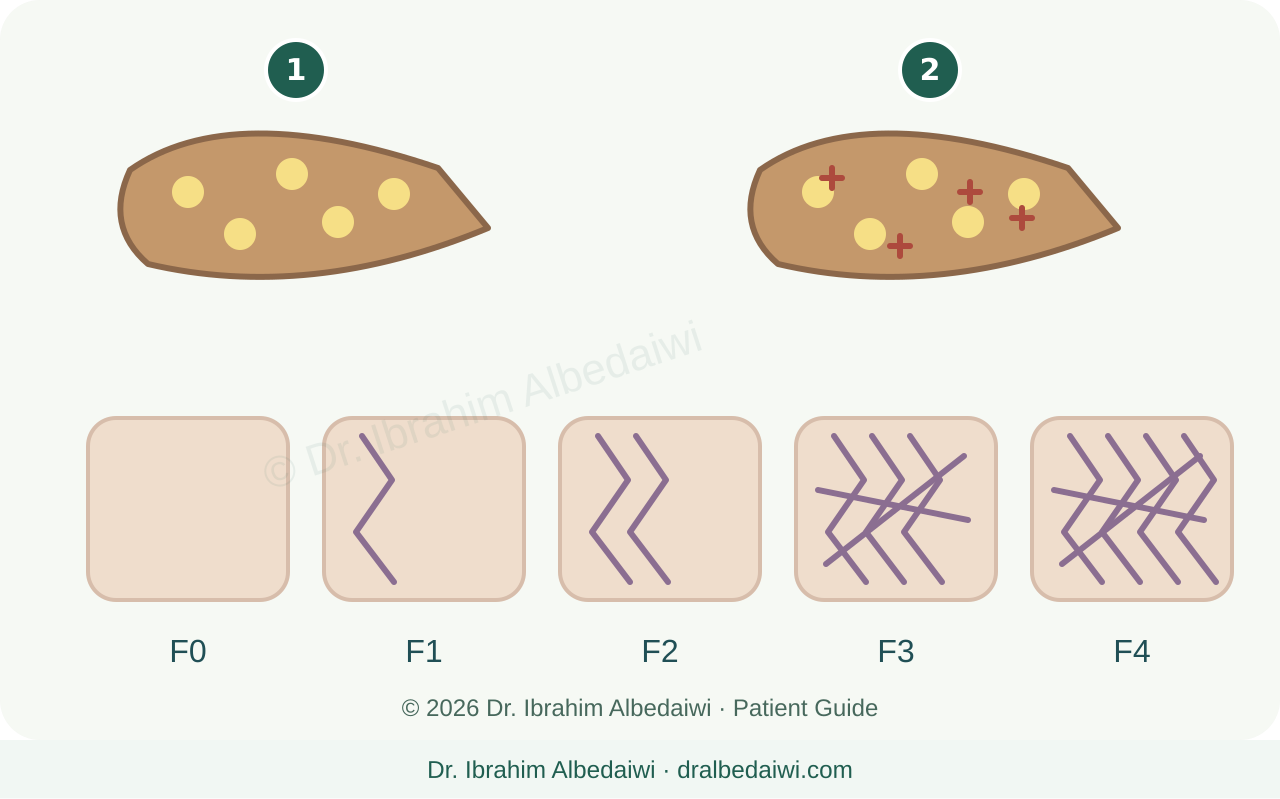
- 1 · Fat accumulation: MASLD
Fat builds up inside liver cells.
- 2 · Steatohepatitis: MASH
Fat accompanies liver-cell injury and inflammation; scars may develop.
- F0 · No fibrosis
This staging system describes scarring, not the amount of liver fat.
- F1–F3 · Fibrosis before cirrhosis
F1: mild · F2: moderate · F3: advanced bridging fibrosis, before F4.
- F4 · Cirrhosis
Extensive scarring alters liver structure and may affect blood flow and function.
Fibrosis can regress when its cause is treated, especially earlier stages. F4 can also improve, but this does not guarantee a normal liver or remove the need for follow-up. Progression is not inevitable; enzymes or stiffness alone cannot establish the stage.
© 2026 Dr. Ibrahim Albedaiwi · Original patient illustrationsWhat is the difference?
- FibroScan is a quick test through the skin that estimates stiffness to help assess fibrosis and may also measure fat. It does not establish the cause of disease by itself.
- Biopsy takes a small sample using local anesthetic, sometimes with sedation, to assess inflammation, the type of disease and fibrosis when the result could change treatment.
Understanding a FibroScan result
- Greater stiffness does not always mean advanced fibrosis; inflammation and recent food intake can affect the result. Your doctor interprets it with blood tests, measurement quality and the underlying disease.
- Do not compare your number with internet cut-offs or another patient’s result. Its meaning may vary with the situation.
Before your appointment
- For FibroScan, follow the center’s food and drink restrictions; many centres request around three hours. Ask beforehand about diabetes medicines and permitted fluids.
- For biopsy, bring all medicines and supplements, particularly blood thinners, aspirin and diabetes medicines. Get written instructions about fasting and stopping or restarting medicines; do not change them yourself.
During and after biopsy
- The sample may be taken through the skin or through a vein in the neck, depending on your condition. Before consent, the team explains the method and risks, particularly pain and bleeding.
- You will remain under observation according to unit instructions. Arrange a companion and transport home, and follow advice about driving, work, exercise and heavy lifting.
Before leaving the unit
- Obtain a contact number, a painkiller and blood-thinner plan, and a date to discuss the result. The report may take several days or longer.
- Not being contacted does not mean the result is normal. Check with the team if the report is later than expected.
When to get help
After biopsy, severe or worsening abdominal, shoulder or chest pain, breathlessness, dizziness or fainting, bleeding, fever or black stool requires urgent assessment.
Unclear fasting, blood-thinner or diabetes medicine instructions, or a delayed biopsy result.
Related guides
Fatty liver and steatohepatitis