

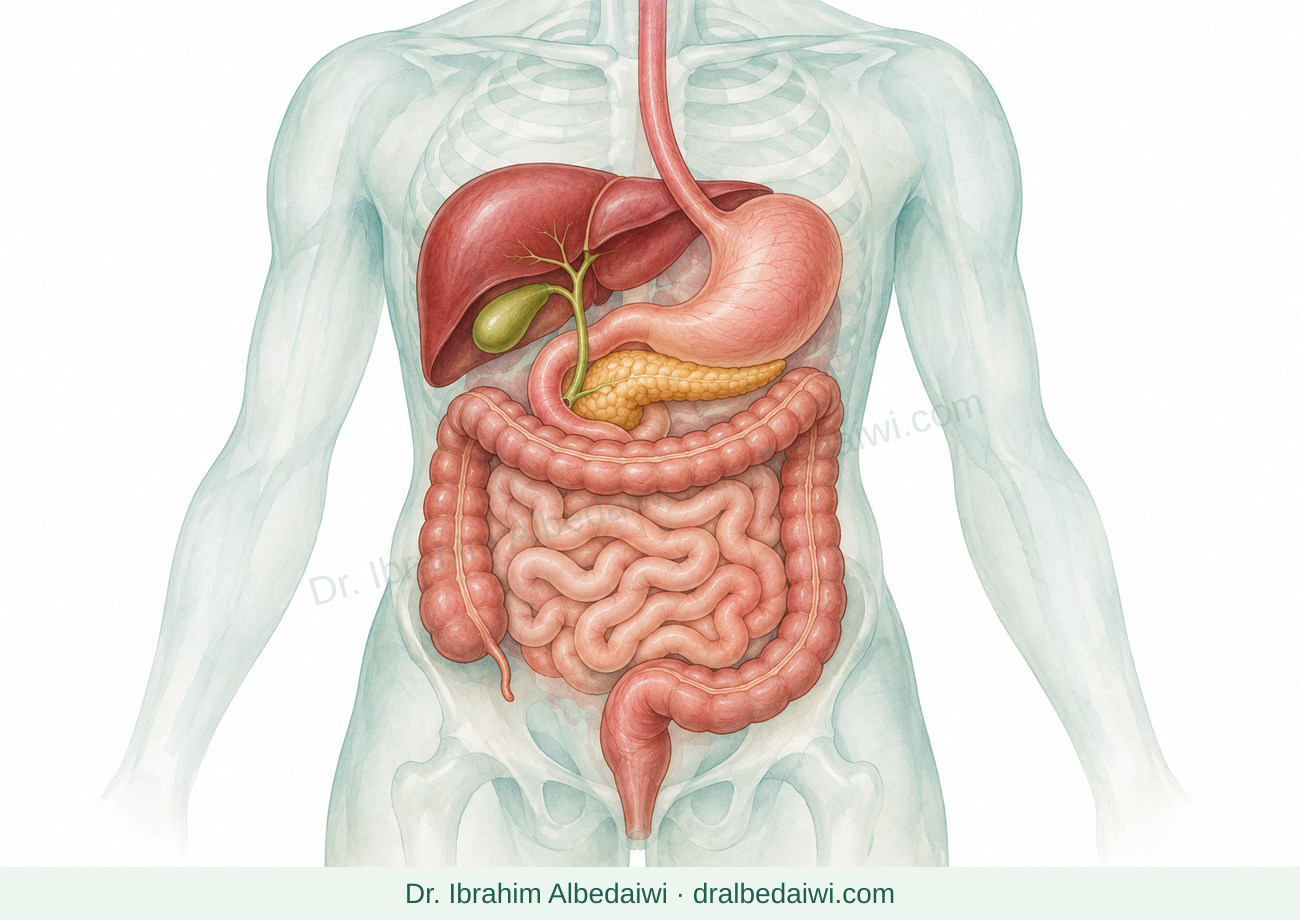

Irritable bowel syndrome
Content date: 15 November 2026
Symptoms are real and can be relieved. IBS is a disorder of gut–brain interaction; it does not damage the bowel or itself increase bowel cancer risk.
Your next step
Choose one change and record its effects, and review the food guide before starting a restrictive diet.
Get urgent help: New severe pain, heavy bleeding or black, tarry stools even without dizziness, persistent vomiting or fainting.
Illustrated FODMAP guide
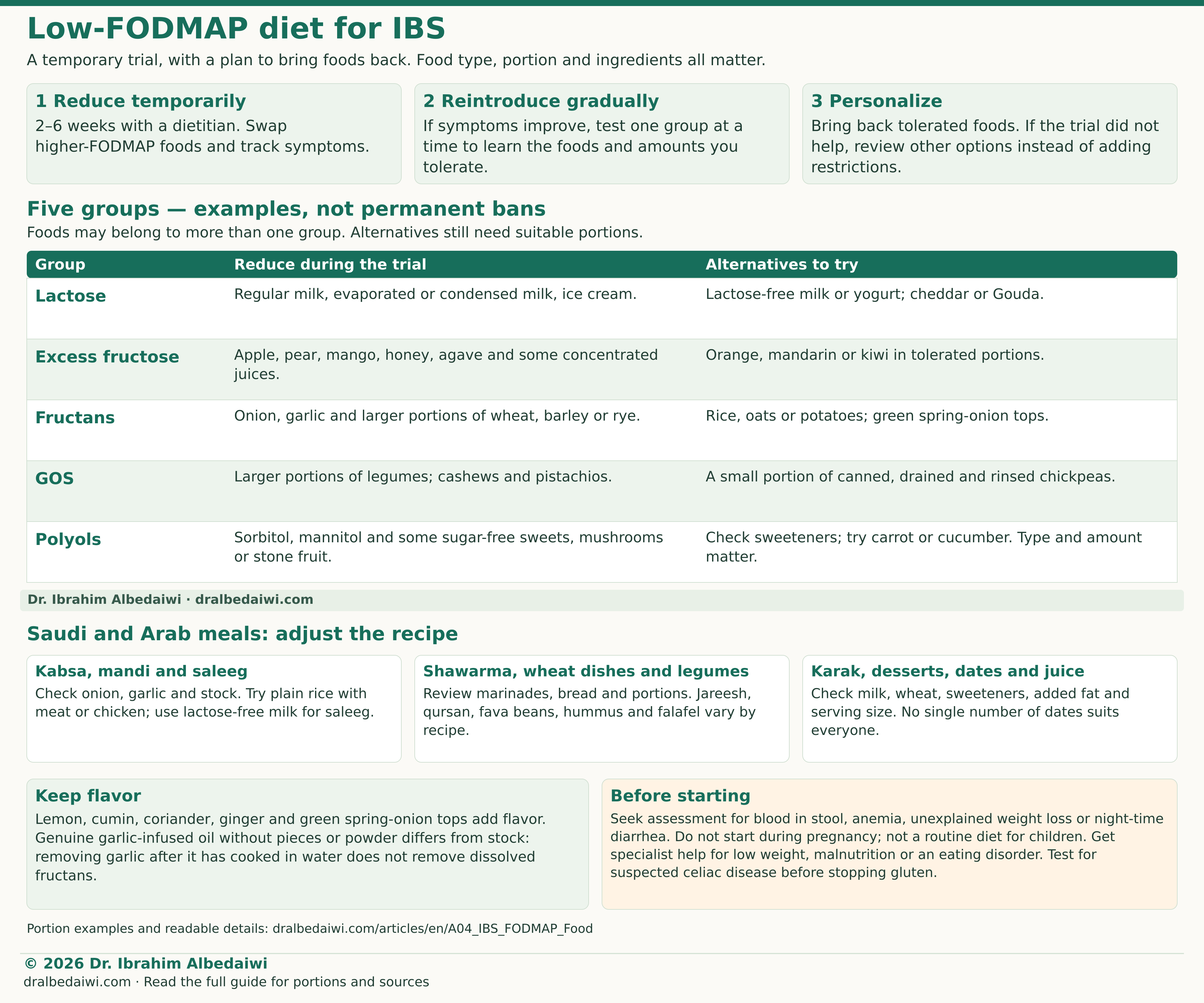
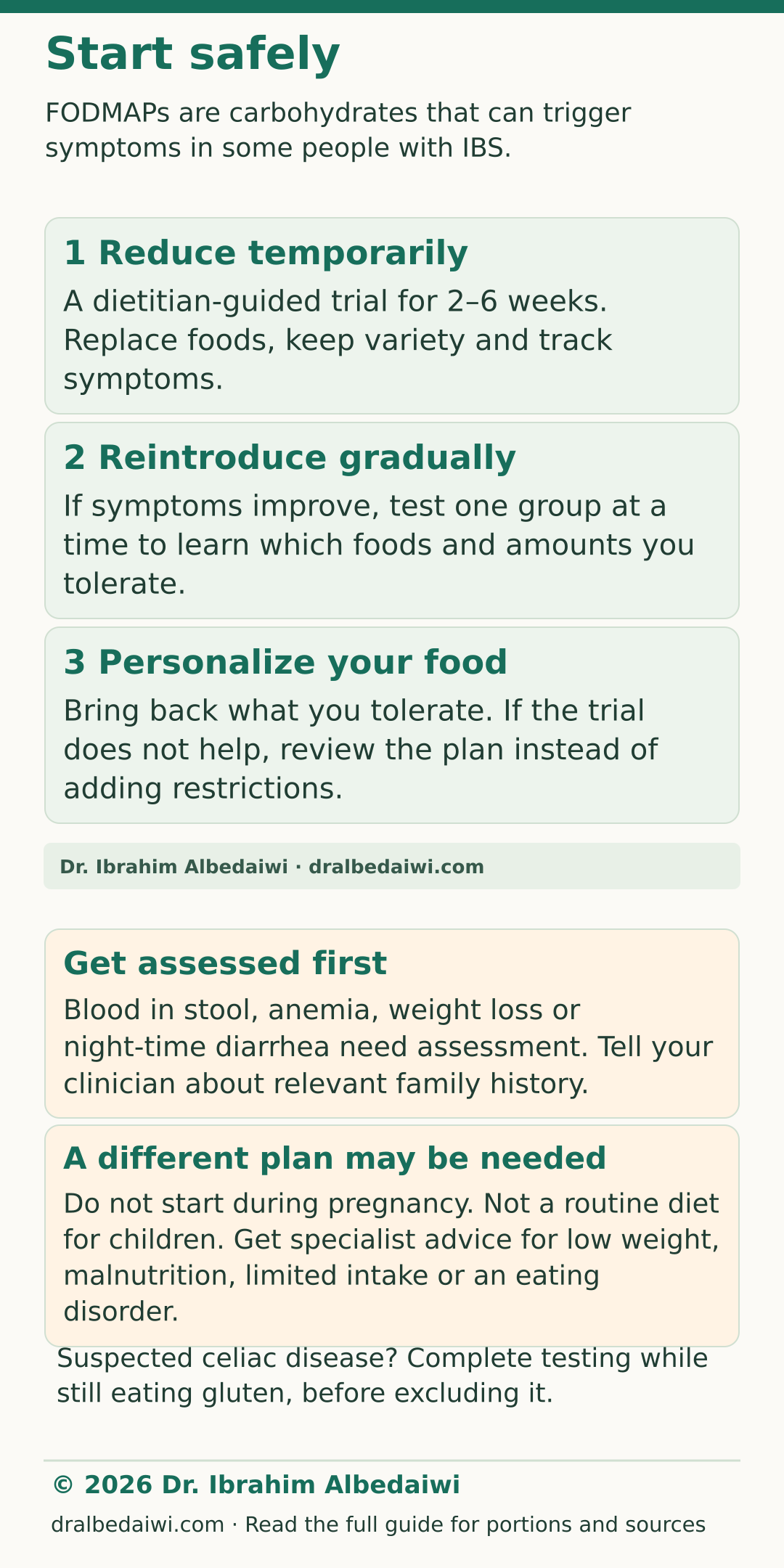
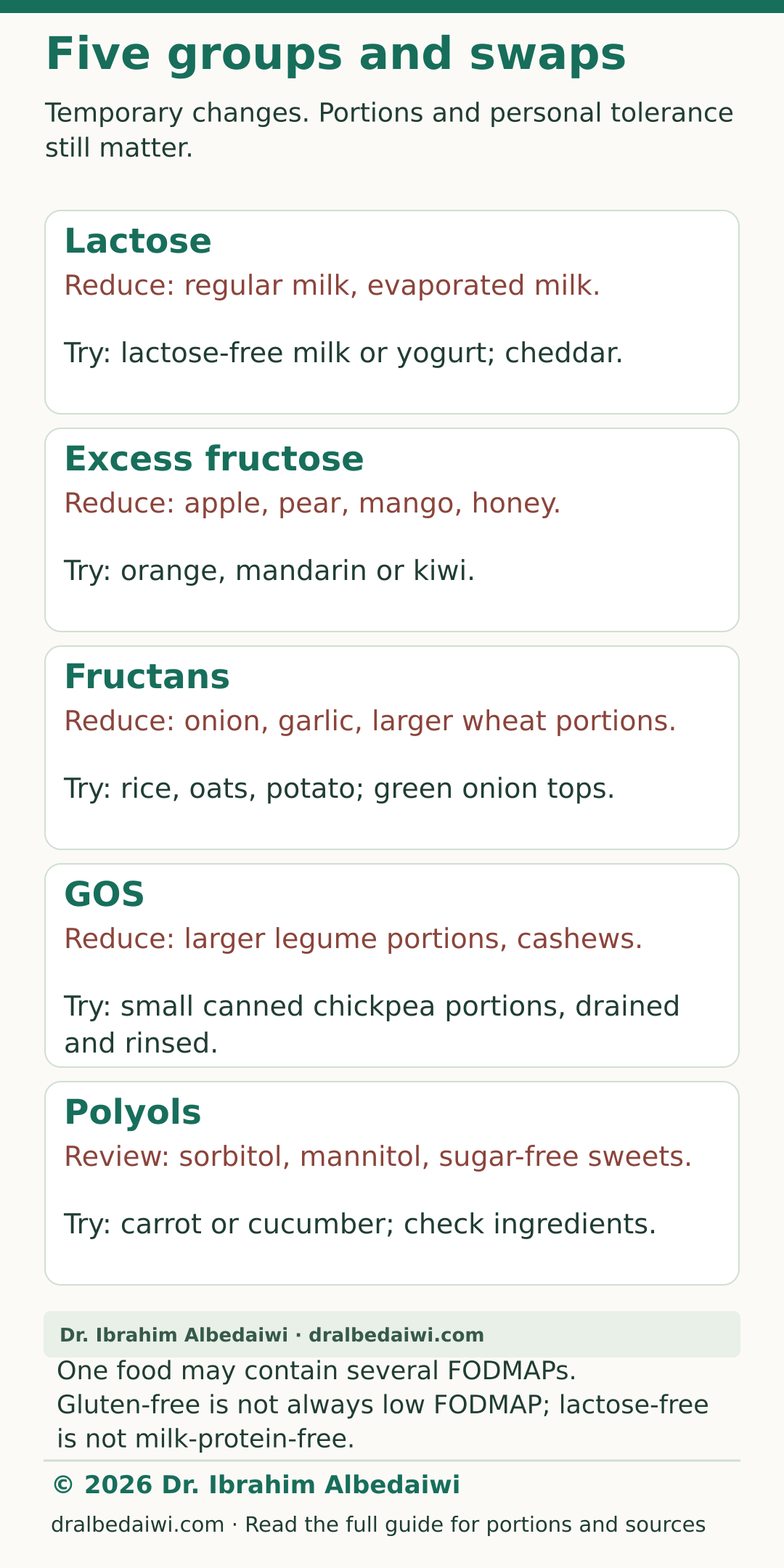
Easier reading on mobile: 3 cards
Scroll the cards horizontally, or select a card to enlarge it. The full guide and portion table follow as readable text.
Understanding the condition: why pain when tests are normal?
- IBS is a disorder of interaction between the gut and brain. Bowel movement and pain signaling work differently, and the bowel may become more sensitive to normal stretching from food or gas. This can cause significant pain and bloating without an ulcer or visible bowel damage.
- The name does not mean the problem is imaginary or that you are “nervous.” Symptoms are physically real and can be influenced by bowel movement, sleep, food and stress; sometimes they start after a gut infection. Constipation predominates in some people, diarrhea in others, and the two may alternate or the pattern change over time.
How does it differ from colitis, and what can we expect?
- IBS is not Crohn’s or ulcerative colitis; it does not itself erode the lining or turn into cancer. However, the diagnosis does not prevent another condition from occurring, so bleeding, weight loss or unusual new symptoms need reassessment. Not all bloating is IBS or evidence of bacterial overgrowth.
- Diagnosis relies on a recurring pattern of abdominal pain associated with bowel movements or changes in stool form and frequency, with selected tests as appropriate. Every possible test and endoscopy is not necessary to establish it. Treatment is tailored to the most troublesome pattern, combining food habits, movement, sleep and suitable medicines when needed. The aim is better ability to eat, work and sleep; control may develop gradually as the plan is adjusted.
What is the difference between IBS and SIBO?
- IBS is a disorder of gut–brain interaction, typically causing recurring pain related to bowel movements or a change in stool frequency or form. SIBO is an abnormal increase or change in bacteria in the small intestine that may cause symptoms, and is more common with certain motility disorders or after particular operations.
- Both can cause bloating, gas, pain and diarrhea, and they can coexist. Symptoms alone do not prove SIBO, and not all IBS is caused by excess bacteria. SIBO may also cause malabsorption or nutrient deficiencies in some patients.
- Your doctor diagnoses IBS from the symptom pattern and selected tests. A hydrogen and methane breath test may be requested if SIBO is suspected; it is not completely accurate and can be misleading, so results are interpreted alongside the history. Not everyone with bloating needs this test.
- Raised methane, particularly with constipation, may indicate intestinal methanogen overgrowth (IMO). These organisms are not bacteria, and this differs from SIBO; they may be in the small or large intestine.
- IBS treatment focuses on diet, activity, sleep, the gut–brain relationship and medicines appropriate to the pattern. If SIBO is considered likely, the doctor treats the cause and nutritional deficiencies and may prescribe a limited antibiotic course. Do not take antibiotics or herbal mixtures yourself; improvement with an antibiotic such as rifaximin does not alone prove SIBO.
IBS and SIBO: similar symptoms, different assessment
Irritable bowel syndrome (IBS)
Involves gut sensitivity, movement and communication with the brain. Diagnosis uses the symptom pattern and assessment of warning signs.
Small intestinal bacterial overgrowth (SIBO)
An abnormal increase in small-bowel bacteria. Your clinician reviews risk factors and may request a breath test in selected cases.
Bloating alone does not prove SIBO, and IBS does not automatically mean SIBO. Do not start or repeat antibiotics yourself.
© 2026 Dr. Ibrahim Albedaiwi · Patient GuideILLUSTRATED PATIENT GUIDE
How to describe your stool
Original schematic drawings based on the Bristol stool classification.

- 1 · Separate hard pellets
Small, firm pieces.
- 2 · Firm and lumpy
A long piece made up of lumps.
- 3 · Formed with cracks
A long piece with cracks on the surface.
- 4 · Smooth and soft
A soft, formed piece.
- 5 · Separate soft pieces
Soft pieces with clear edges.
- 6 · Mushy pieces
Loose pieces with uneven edges.
- 7 · Watery
Liquid without formed pieces.
Types 1–2 can accompany constipation, 3–4 are usually formed stool, and 6–7 are loose or watery. Shape alone does not diagnose illness; also describe frequency, pain and any blood.
© 2026 Dr. Ibrahim Albedaiwi · Original patient illustrationsHow is it diagnosed?
- Diagnosis is based on the symptom pattern, examination and selected tests appropriate to your situation. We may test for celiac disease or inflammatory bowel disease when needed.
- Not everyone needs a colonoscopy, but bleeding, anemia, weight loss or family history may change the investigation plan.
Common IBS patterns
| Pattern | What it means |
|---|---|
| IBS-C | Constipation predominates. |
| IBS-D | Diarrhea predominates. |
| IBS-M | Both constipation and diarrhea occur. |
Treatment matches your pattern
- Soluble fiber such as psyllium may help when increased gradually; coarse bran may worsen bloating for some people.
- Your doctor may prescribe treatment for constipation, diarrhea or cramps, and sometimes a medicine at an appropriate dose to regulate pain signals between the gut and brain.
Exercise is part of treatment
- Regular activity may improve IBS symptoms, although the evidence is limited and it is not a cure. Start with a comfortable 10–15-minute walk, or less if needed, and build up gradually. Choose activity that suits your symptoms and toilet access.
Food without unnecessary complexity
- Eat regularly and slowly, and review coffee, fizzy drinks and sweeteners if they trigger symptoms. Keep a food-and-symptom diary instead of excluding many foods at once.
- Some patients benefit from a dietitian-guided low-FODMAP trial followed by reintroduction. The food guide below explains the stages, suitable portions and situations where restriction needs specialist advice.
- Food amount and preparation matter. Wheat can cause symptoms because of fructans; this alone does not establish gluten sensitivity.
Psychological care is part of IBS care
- The gut and brain constantly exchange signals. Anxiety and stress may increase gut sensitivity and pain, while ongoing symptoms can increase anxiety in turn. This is a real physical interaction; it does not mean symptoms are imaginary or that everyone with IBS has a mental health disorder.
- Regular sleep, activity and relaxation exercises may help. Gut-directed cognitive behavioral therapy or gut-directed hypnotherapy with a qualified professional may also help, even without diagnosed depression or anxiety.
- We may recommend a psychologist and psychiatric follow-up when needed, particularly when anxiety, depression or fear of symptoms affects sleep, work or relationships, or distress persists despite treatment. Assessment determines the right support or medicine in coordination with your gastroenterologist.
- Seeking psychological support is a normal treatment step alongside gastrointestinal and nutritional care. Some medicines regulate pain signaling at appropriate doses even without depression; do not start or stop them yourself, and do not attribute new warning signs to stress without assessment.
Sleep and follow-up
- Keep a regular sleep routine and review your symptoms and treatment response over several weeks.
- Do not start antibiotics or herbal bowel cleanses yourself, and do not assume every new pain is IBS.
- If you do not improve, we review the diagnosis, treatment and nutrition together.
Treatment options and further reading
Low-FODMAP diet for IBS
A temporary trial, not permanent deprivation. Explore the three stages, five groups, Saudi meals and published portion examples. Food type, amount and ingredients all matter.
What are FODMAPs, and what is the aim?
FODMAPs are carbohydrates that may be poorly absorbed. Their fermentation can increase gas, pain or diarrhea in some people with IBS.
The diet may help symptoms, but it is not a treatment for every cause of bloating and not everyone with IBS needs it. Aim for the widest variety you can tolerate with the fewest necessary restrictions.
Three stages, not a permanent exclusion list
1. Reduce temporarily
For 2–6 weeks with a dietitian, swap higher-FODMAP foods for suitable alternatives and track symptoms.
2. Reintroduce gradually
If symptoms improve, test one group at a time with your dietitian to learn which foods and amounts you tolerate.
3. Personalize your food
Bring back foods you tolerate. Limit only what troubles you and only as much as needed; tolerance can change.
If symptoms do not improve during the trial, do not prolong the first stage or add more restrictions. Review the plan and other treatment options with your clinician and dietitian.
Unexplained weight loss, blood in stool, anemia or diarrhea that wakes you from sleep need medical assessment before you assume IBS is the cause. Tell your clinician about a family history of bowel cancer, Crohn’s disease, ulcerative colitis or celiac disease.
Do not start this restrictive diet during pregnancy. It is not recommended as a routine diet for children. Seek specialist advice first if you are underweight, have malnutrition, already eat a limited range, or have a current or past eating disorder.
If celiac disease is suspected, complete testing while you are still eating gluten, before excluding it. A low-FODMAP diet does not necessarily mean a gluten-free diet.
The five groups: examples, not absolute rules
These are grouped into five categories for simplicity. Foods can contain more than one type; the alternatives are not suitable in every amount or for every person.
Lactose (milk sugar)
Reduce temporarily: Regular milk and some milk products, including evaporated or condensed milk and ice cream.
Alternatives to try: Try lactose-free milk or yogurt, or lower-lactose cheeses such as cheddar or Gouda.
- Cow, goat, sheep and camel milk are not naturally lactose-free.
- Lactose varies in yogurt and softer cheeses such as ricotta and cottage cheese, depending on the product and portion. You do not need to exclude all dairy.
- Lactose-free cow’s milk is not suitable for cow’s-milk protein allergy.
Excess fructose (some fruit and sweeteners)
Reduce temporarily: Apple, pear, mango, honey, agave syrup and some concentrated juices.
Alternatives to try: Try orange, mandarin or kiwi in amounts you tolerate.
- Check drink and dessert ingredients, including high-fructose corn syrup.
- Large portions of dried fruit or juice may cause symptoms; juices differ in fruit, concentration and quantity.
- A food can contain more than one FODMAP type. Apples are not only a source of fructose.
Fructans (onion, garlic and some grains)
Reduce temporarily: Onion, garlic, asparagus, white spring-onion parts, and larger portions of wheat, barley or rye.
Alternatives to try: Try rice, oats or potatoes; use green spring-onion tops for flavor.
- Bread, pasta, biscuits, cakes and pastries differ by ingredients and portion. Wheat products are not permanently forbidden.
- Look for onion and garlic powders in stock, sauces, marinades and spice mixtures.
- Fructans may cause symptoms rather than gluten. A gluten-free label does not guarantee a low-FODMAP product.
- Check for added inulin, chicory-root fiber and FOS in protein bars, yogurt and high-fiber products.
GOS (sugars in some legumes)
Reduce temporarily: Larger portions of dried beans, chickpeas, lentils and peas, plus cashews and pistachios.
Alternatives to try: A small portion of canned chickpeas, drained and rinsed, may suit you. Not all legumes need to be excluded.
- Type, amount and preparation matter. Whole chickpeas are different from hummus dip containing garlic.
- Green beans are different from dried bean seeds.
- Groups overlap: cashews also contain fructans.
Polyols (sugar alcohols)
Reduce temporarily: Sweeteners such as sorbitol and mannitol, and some mushrooms, cauliflower and stone fruit.
Alternatives to try: Check sugar-free products. Try carrots and cucumber instead of vegetables that trouble you.
- Xylitol, maltitol and isomalt may also be present in sugar-free gum and sweets.
- Peaches, apricots, plums, cherries and blackberries vary by type and portion; this is not a lifelong ban.
- Mushrooms, cauliflower, avocado and celery need attention to type and amount, not automatic exclusion.
- Sweeteners differ. Ordinary sugar is not a polyol; read the ingredient name rather than relying on packaging or additive numbers.
Everyday options for variety
Fruit
- Orange, mandarin, kiwi, pineapple and papaya can be options in suitable portions.
- A firm, less-ripe common banana differs from a very ripe banana; a smaller ripe portion may be tolerated.
- Cantaloupe, passionfruit, strawberries, blueberries and raspberries depend on portion size.
- Fresh cranberries differ from dried, sweetened versions and juice. Check grape and grapefruit portions; lemon is usually used in seasoning amounts.
- Spread fruit through the day. An alternative is not an unlimited portion.
Vegetables
- Carrot, cucumber, lettuce and potato are practical choices. Spinach, eggplant, green beans and zucchini can add variety with suitable portions.
- Bell-pepper portions vary by color and type, and tomatoes by variety. Review amounts if symptoms recur.
- Olives, parsley, coriander and ginger add variety and flavor. Check the part and portion used for parsnip and fennel; fennel as a vegetable differs from fennel tea.
- Broccoli heads differ from stalks; green spring-onion tops differ from white parts.
- Celery and sweet potato need portion awareness, not automatic exclusion.
Starches and grains
- Rice, oats, quinoa, millet and rice or corn pasta are practical options.
- Choose bread by its ingredients and portion; gluten-free wording alone is not enough.
- Check the product and serving when using tapioca, arrowroot or sorghum.
- Barley and rye contain gluten and are not gluten-free substitutes for someone with celiac disease.
Dairy and alternatives
- Try lactose-free milk and yogurt. Cheddar, Gouda, Brie or Camembert may also fit, depending on portion.
- Almond and rice milks vary by product and amount. Choose calcium-fortified alternatives and check added ingredients.
- Soy milk made from soy protein differs from milk made from whole soybeans; read the ingredients.
- Check lactose and sweeteners in ice-cream alternatives. Persistent symptoms after changing milk need review, not increasingly random exclusions.
Protein, fats and sweeteners
- Plain eggs, meat, chicken and fish are usually suitable; check the marinade and sauce.
- Use olive oil or butter moderately. A fatty meal may trigger symptoms even if low in FODMAPs.
- Small amounts of ordinary sugar, glucose or maple syrup may fit. Molasses and date syrup are not guaranteed substitutes; products and portions differ.
- Walnuts and peanuts can add variety in suitable portions if you are not allergic. Small portions of almonds or hazelnuts may also be tolerated.
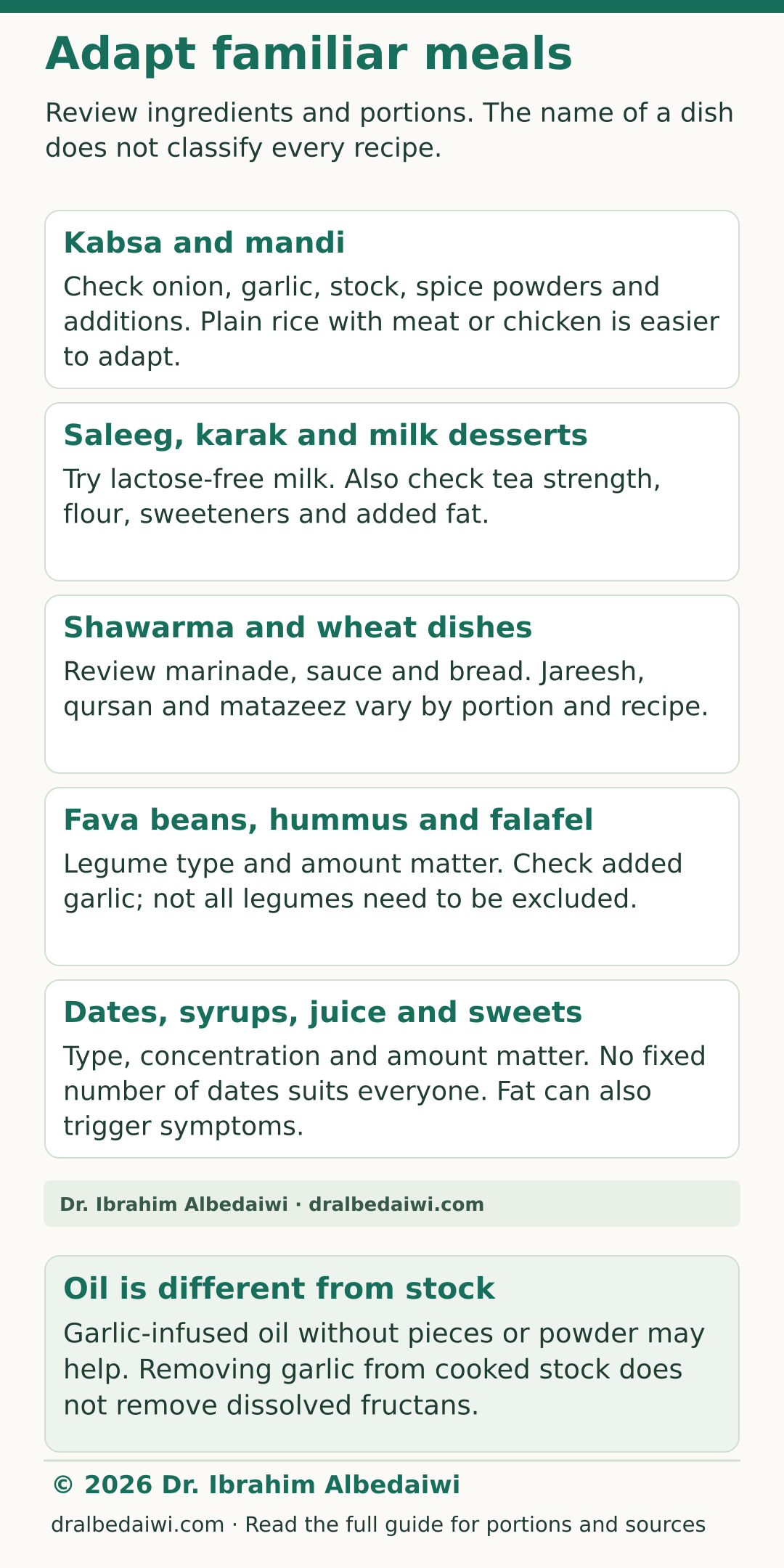
Saudi and Arab meals
These are ingredient-based adaptations, not a single judgment on every recipe or a claim that each dish has been laboratory tested.
| Dish or drink | What should I adjust or check? |
|---|---|
| Kabsa and mandi | Try rice with meat or chicken prepared without onion or garlic. Check stock, spices, raisins and other additions; the dish name alone does not determine its suitability. |
| Saleeg | Try lactose-free milk and check stock and seasoning. Suitability depends on the recipe and portion. Check ordinary milk added to coffee too. |
| Shawarma and grills | Ask about onion and garlic in marinades and sauces, and the type and amount of bread. Plain protein with rice or potato and tolerated vegetables may be easier to adapt. |
| Jareesh, qursan and matazeez | These are often wheat-based. Review the portion plus onion and garlic in the recipe. Rice or quinoa may be alternatives during the reduction stage. |
| Fava beans, hummus, lentil soup and falafel | Legume type, amount and preparation differ, and onion or garlic may be added. You need not exclude them all; discuss a suitable small portion and preparation. |
| Muhallabia and umm Ali | Lactose-free milk may help, but also check wheat, nuts, dried fruit and the other recipe ingredients. |
| Karak | Check the amount of evaporated or condensed milk. Try lactose-free milk and review tea strength, caffeine and sweeteners. |
| Juice | Fruit type, concentration, amount and additions matter. A measured portion of whole fruit can make portion control easier. |
| Dates and date syrup | Date size, variety and amount matter. There is no three-dates rule that suits everyone, and syrups should not all receive the same classification. |
| Luqaimat and kunafa | Review flour, milk, cream, sweeteners and portion. Fat may also trigger symptoms through a mechanism separate from FODMAPs; recipes are not equivalent. |
| Herbal tea | Not every herbal tea is low FODMAP. An older published test of a 250 mL cup classified chamomile and fennel tea as higher FODMAP. Check type, strength and portion; this does not classify every preparation or verify current app values. |
How can I keep the flavor?
Try lemon, cumin, coriander, ginger and green spring-onion tops. A commercial oil genuinely infused with garlic, without garlic pieces or powder, can add flavor; check its ingredients. Removing onion or garlic pieces after cooking them in water-based soup or stock does not remove the fructans that have dissolved into the water.
Serving examples from published sources
These examples are for one serving at a meal, not daily limits or guarantees of tolerance. Variety, preparation and product matter; weight is more reliable when pieces differ in size. Public sources were checked, not the app database directly.
| Food and preparation | Serving example | What to check | Source |
|---|---|---|---|
| Brown rice, boiled | 180 g 1 cooked cup | Weigh after cooking; check added ingredients. | 2 |
| Plain rolled oats, dry | 52 g ½ cup before cooking | Check added milk and sweeteners. | 2 |
| Cucumber | 75 g | A vegetable serving example, not a fixed maximum. | 3 |
| Carrot, raw and peeled | 75 g 1 medium carrot | Weight is more reliable when sizes differ. | 2, 3 |
| Cantaloupe | 120 g ¾ cup | Do not apply this to every melon variety. | 1 |
| Strawberries | 5 medium berries | Size matters; this source does not specify a weight. | 1 |
| Zucchini | 65 g | A portion example, not an unlimited amount. | 1 |
| Canned chickpeas, drained | 42 g ¼ cup | Rinse them; this is not a hummus-dip portion. | 2 |
| Common banana, unripe and firm | 100 g 1 medium banana | Do not use the same portion for very ripe banana. | 2 |
| Almonds with skin | 12 g 10 nuts | Consider nut allergy. | 2 |
| Green beans | 75 g About 15 pods | Different from dried bean seeds. | 2, 3 |
| Sweet potato | 75 g | Larger portions may have a different FODMAP content. | 3 |
Should I worry about combining foods?
You can combine several low-FODMAP foods in one meal. If symptoms are controlled, there is no need to become preoccupied with stacking portions. If symptoms persist, review meal size, additions and combined portions with your dietitian rather than excluding more foods at random.
Fiber and psyllium
Psyllium is a soluble-fiber supplement, not a type of bread. It may help some IBS symptoms and is increased gradually with fluids according to professional advice. Keep fiber and food variety; do not reduce the diet to rice and meat alone.
Probiotics
They are not an essential part of this diet, and benefit varies by strain and person. Discuss whether a trial is appropriate and how long to try it; do not assume all products have the same effect.
Planning reintroduction
Challenge groups one at a time, keeping the rest of your food as stable as possible and recording symptoms. Your dietitian may test sorbitol separately from mannitol. A complex meal with many ingredients is not a useful test of one group.
Not every symptom comes from FODMAPs
Caffeine, fat, meal size and other factors can influence symptoms. Low-FODMAP food is not necessarily free of allergens and does not guarantee no symptoms.
Sources and review limits
Content updated: 15 November 2026. Portion-table source numbers match this list. The portions come from the dated public sources below, not a direct check of the latest app database or a substitute for an individual plan.
- Monash University: three-step diet and food examples (2026)
- Monash University: Getting enough fibre (14 January 2021)
- Monash University: Low FODMAP Shopping List (3 February 2025)
- AGA: role of diet in IBS (2022)
- Monash University: FODMAP stacking explained
- Monash University: cooking with onion and garlic
- Monash University: hot-beverage testing (October 2013; not current app verification)
- ESPGHAN/NASPGHAN: childhood IBS and functional abdominal pain guideline (2025)
- Monash University: the low-FODMAP diet during pregnancy
- NIDDK: IBS diagnosis and warning signs
- Monash University: reading ingredient labels
Aim for the widest variety you tolerate, not the longest exclusion list. Agree the trial and reintroduction plan with your dietitian and do not ignore warning signs.
When to get help
New severe pain, heavy bleeding or black, tarry stools even without dizziness, persistent vomiting or fainting.
Recurring blood in stool, unexplained weight loss, anemia, fever, or diarrhea that wakes you from sleep.
Guides for your care journey
Read the related guides together:
Related guides
Eating with irritable bowel syndrome
Constipation, difficult evacuation and bowel leakage
Medicines for irritable bowel syndrome (IBS)
Low-dose amitriptyline for IBS
Probiotics: when can they help?
Sources
NIDDK: Psychological therapy and IBS symptoms
NIDDK: Irritable bowel syndrome
Clinical guidelines: ACG 2021 guideline; current portal
ACG: Small intestinal bacterial overgrowth
Monash University: three-step diet and food examples (2026)
Monash University: Getting enough fibre (14 January 2021)
Monash University: Low FODMAP Shopping List (3 February 2025)
AGA: role of diet in IBS (2022)
Monash University: FODMAP stacking explained
Monash University: cooking with onion and garlic
Monash University: hot-beverage testing (October 2013; not current app verification)
ESPGHAN/NASPGHAN: childhood IBS and functional abdominal pain guideline (2025)
Monash University: the low-FODMAP diet during pregnancy