



Biologic infusions: what to expect
Content date: 10 November 2026
Medicine is given slowly through a small tube in a vein while you remain awake and nurses monitor you. Treatment and observation times depend on the medicine and your health.
Your next step
Confirm your medicine and appointment. Contact the unit beforehand if you develop a fever or infection, or start an antibiotic.
Get urgent help: During treatment, tell the nurse immediately about breathing difficulty, facial or throat swelling, chest pain or fainting. After leaving, seek emergency care for these symptoms; do not wait for a message reply.
Infusion or injection under the skin?
- Some medicines are given through a vein in a treatment unit; others are injected under the skin after training. Treatment may start intravenously and later change to injections to keep the disease settled. Your clinician selects the product, dose and schedule; do not switch routes yourself.
ILLUSTRATED PATIENT GUIDE
Your intravenous biologic infusion
What to expect before, during and after treatment.
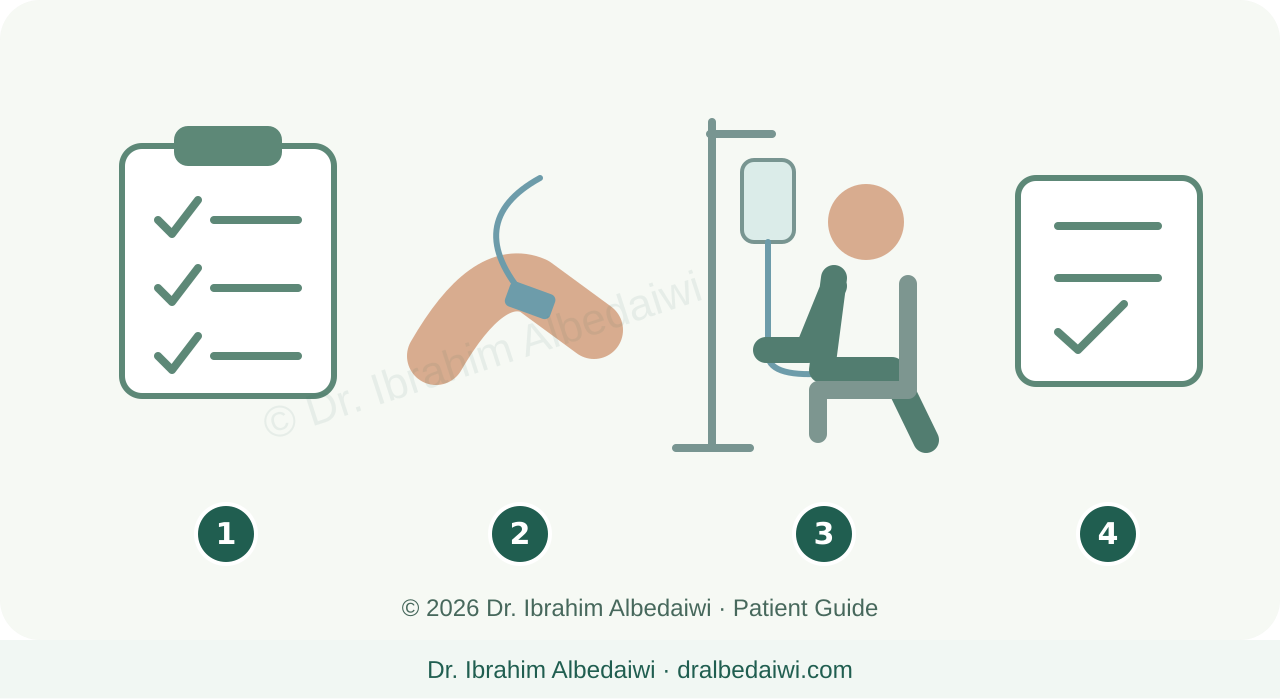
- 1 · Before starting
The team asks about symptoms, infections and medicines, checks vital signs and reviews required tests.
- 2 · Placing a cannula
A small needle places a thin plastic tube in a hand or arm vein. The needle is removed; the tube stays in place.
- 3 · Medicine and monitoring
Medicine runs gradually through the tube while you are awake. Session length varies by drug and dose; extra medicines may be given when needed.
- 4 · After the infusion
You may stay for observation, then receive home-care instructions and your next appointment.
Tell the nurse immediately about itching, a rash, sudden flushing, dizziness, chest tightness or breathing difficulty. Not all biologics are intravenous; some use injections under the skin.
© 2026 Dr. Ibrahim Albedaiwi · Original patient illustrationsBefore your appointment
- Report fever, persistent cough, infection, antibiotics or a previous reaction. The team may postpone treatment after assessing you. Bring a medicine list, complete requested tests, and disclose pregnancy or pregnancy plans.
- An infusion alone usually does not require fasting. Eat and drink within your usual medical restrictions unless the unit gives different instructions. Wear clothes allowing access to your arm and bring something to read. Allow time for preparation and observation.
On arrival
- Staff review your health, prescription and tests, check blood pressure, pulse and temperature, and may weigh you. A cannula—a small plastic tube—is placed in a hand or arm vein after a brief needle prick. Preparing the medicine may take time.
- Premedication may be prescribed to reduce reactions, but is not required for everyone. Do not add steroids or antihistamines yourself.
While the medicine is running
- You sit in a chair or bed while the medicine runs through tubing at the prescribed rate. You may read or use your phone, and usually eat or drink if the unit permits. Ask for help before walking or using the toilet.
- You may feel nothing unusual. Tell the nurse immediately about itching, rash, flushing, headache, nausea or chills, or pain, burning or swelling around the cannula. Do not silently tolerate symptoms or adjust the pump. Staff may slow or pause treatment and assess you.
After the infusion and at home
- The line may be flushed with saline, followed by observation according to the product, unit policy and previous reactions. Infusion time is not total visit time. Stay until staff say you can leave.
- Mild fatigue or headache may occur. Do not drive if dizzy or sleepy, or after medication that makes you drowsy. Plan suitable transport, especially for the first visit. Before leaving, confirm the next dose, blood tests and contact details.
- Delayed reactions can occur after leaving, sometimes days later, especially with infliximab. Report new rash, fever or joint pains. Breathing difficulty, facial swelling or fainting requires emergency care.
If treatment changes to home injections
- Train with your exact pen or syringe. Wash your hands, check the name, strength and expiry, rotate sites as instructed and avoid inflamed or bruised skin. Devices and permitted time out of the refrigerator differ. Do not heat the medicine or copy another device’s instructions. Use a sharps container.
- Improvement may take weeks and varies by medicine. Lack of improvement after one infusion does not automatically mean failure; do not stop when symptoms improve. Contact the team if a dose is missed or instructions are unclear.
How long does the medicine take?
Adult examples below describe infusion time only. Preparation and observation add to the visit.
| Medicine | Time for the intravenous dose |
|---|---|
| Infliximab | Usually at least two hours initially. A shorter infusion may later be allowed for selected products and suitable patients under the unit protocol. |
| Vedolizumab | About 30 minutes. The referenced leaflet specifies about two hours of observation after the first two infusions and about one hour after later infusions. Follow your unit’s instructions. |
| Ustekinumab | At least one hour for the initial intravenous dose, usually followed by injections under the skin. |
| Risankizumab, when intravenous induction is prescribed | At least one hour for the Crohn’s intravenous dose, or at least two hours for the ulcerative-colitis intravenous dose. |
Ask your unit about the expected total visit time. Observation may be longer if symptoms occur; plans vary by product and individual circumstances.
When to get help
During treatment, tell the nurse immediately about breathing difficulty, facial or throat swelling, chest pain or fainting. After leaving, seek emergency care for these symptoms; do not wait for a message reply.
Contact the team promptly for fever or infection before a dose, or rash, joint pains or persistent symptoms afterwards. Fever with severe illness needs urgent assessment.